
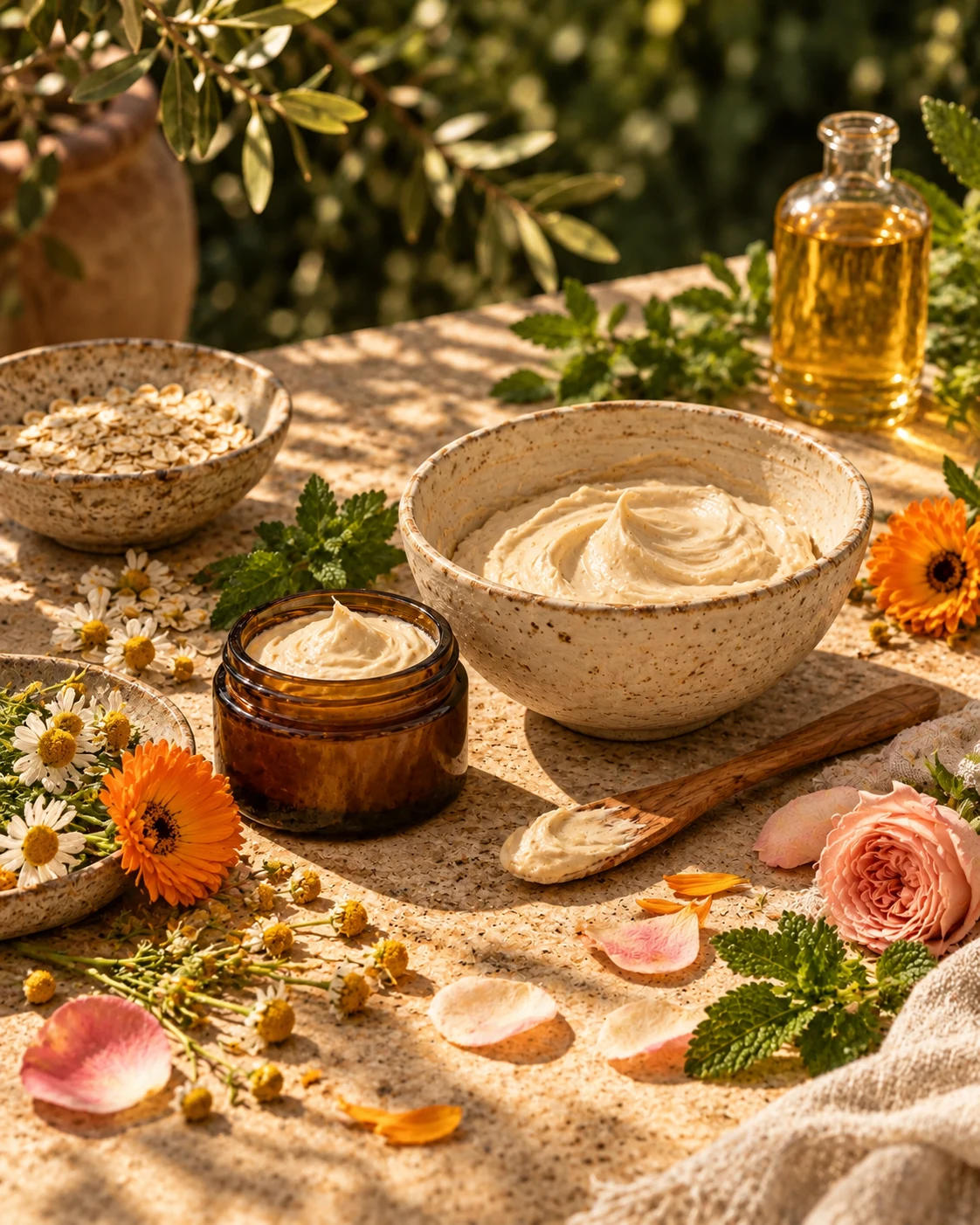
Some of the most interesting plants on the beauty shelf are the ones we almost overlook. Oats are a lovely example. Familiar. Unassuming. More likely to remind us of a kitchen than a laboratory.
And yet, this little grain has a place in both.
I’m drawn to ingredients that invite us to pay closer attention to something ordinary. A bowl of oats. A ceramic jar. The feel of a cream that leaves the skin comfortable. Beauty can begin there, without becoming another project we have to perfect.
A plant with a long memory
Avena sativa is the botanical name behind the oat. Its history of topical use for dry, uncomfortable skin predates the modern skincare aisle. That history matters. Generations of observation are a form of knowledge, and they help shape the questions we bring into the laboratory.
Colloidal oatmeal is a finely processed oat ingredient prepared for use in skin products. A finished formula containing it is different from a handful of breakfast oats, and evidence for one preparation cannot simply be transferred to the other.
What the skin research adds
A 2016 study combined laboratory work with an investigation involving 50 women with dry lower-leg skin. The tested colloidal-oatmeal lotion improved measures of dryness, hydration, and barrier function. The laboratory work explored processes related to barrier proteins, lipids, and pH. These findings help explain why a familiar ingredient can feel so useful in a thoughtfully made formula.1
The microbiome adds another layer. In a short randomized study with 61 completers who had mild to moderate eczema, researchers compared a cream containing 1% colloidal oatmeal with a standard moisturizer. The oat cream improved several barrier measures and showed trends in microbial composition and diversity. The study was brief, the authors worked for the manufacturer, and the findings concern that particular formula and population. They do not establish that every oat product can “rebalance” anyone’s microbiome.2
Still, I find the question beautiful: how might caring for the skin’s environment also influence the organisms that live there?
A ritual of softness
For me, the spiritual part of caring for the body begins with the quality of our attention. Can we touch our skin without immediately looking for something to correct? Can we let an ordinary evening contain a small act of tenderness?
Try making space around a familiar moisturizer. A clean towel. A bowl of flowers nearby. A moment to notice the temperature of your hands. Use a product your skin already tolerates, following its directions, and allow the ritual to be simple.
The flowers can remain on the table. Their beauty does not depend on becoming another ingredient.
Let your skin have a say
Avoid oat preparations if you have a known oat allergy. Introduce unfamiliar products cautiously; testing on a small area first can help identify a reaction, though it cannot guarantee tolerance. Stop if redness, itching, or swelling appears.3 Persistent irritation deserves additional care from a qualified clinician or skin specialist.
There is room for the old knowledge and the new research. And there is room for the quiet experience of caring for yourself, which deserves attention all its own.
References & further reading
- Ilnytska et al. (2016) — Colloidal Oatmeal (Avena sativa) Improves Skin Barrier Through Multi-Therapy Activity. Laboratory experiments and a clinical study of dry skin.
- Capone et al. (2020) — Effects of Colloidal Oatmeal Topical Atopic Dermatitis Cream on Skin Microbiome and Skin Barrier Properties. Short randomized study; manufacturer-affiliated authors.
- American Academy of Dermatology — How to test skin care products.
For education and reflection. Individual needs vary. For persistent symptoms or personal guidance, seek additional care from a qualified clinician or appropriate specialist.