
NOURISH
Build from the kitchen.
Protein, colorful plants, fiber, and regular meals create the daily foundation.
Search the whole journal across all categories, or explore the plant library:
Everyday nourishment · Environmental health
Botanical wisdom. Everyday nourishment.
My approach to detoxification begins with the life around you: the meals that nourish you, the water you drink, the air you breathe, and the rhythms that help you feel well. This is my complete edit of six nutritional and botanical selections, with a closer look at their ingredients and the questions that guide my lab choices.
Opens the collection on Fullscript. Choose individual products; current labels, availability, and prices are shown there.

From the doctor · A naturopathic perspective
My approach to detoxification begins with the foundations: nourishing meals, comfortable digestion, restorative rest, and a closer look at what we encounter every day. I begin by understanding the conditions around your health, then consider where additional support may be useful.
This edit brings together botanicals, nutrients, and testing options through that naturopathic and functional medicine lens. Each has a different role. The right choice begins with your story, your daily rhythms, and a clear reason for using it.
NOURISH
Protein, colorful plants, fiber, and regular meals create the daily foundation.
SUPPORT
Look at the role of each nutrient and botanical, then consider the preparation.
EXPLORE
An exposure history gives laboratory testing a direction and a next step.
Build meals around enough protein, colorful plants, and a variety of whole foods. Your body uses amino acids and micronutrients in the everyday work of metabolism. Give that work a well-stocked kitchen.
Fiber, fluids, movement, and a regular toileting rhythm support comfortable bowel function. Increase fiber gradually, and give persistent constipation attention before considering a binder.
A consistent sleep window, time outdoors, and movement you enjoy help create a rhythm you can return to. Begin with one small practice that fits the life you actually live.
Take a practical look at smoke, indoor air, water, work exposures, and the products you use. When a concern is specific, investigate its source and make a targeted change.
02 · Inside the edit
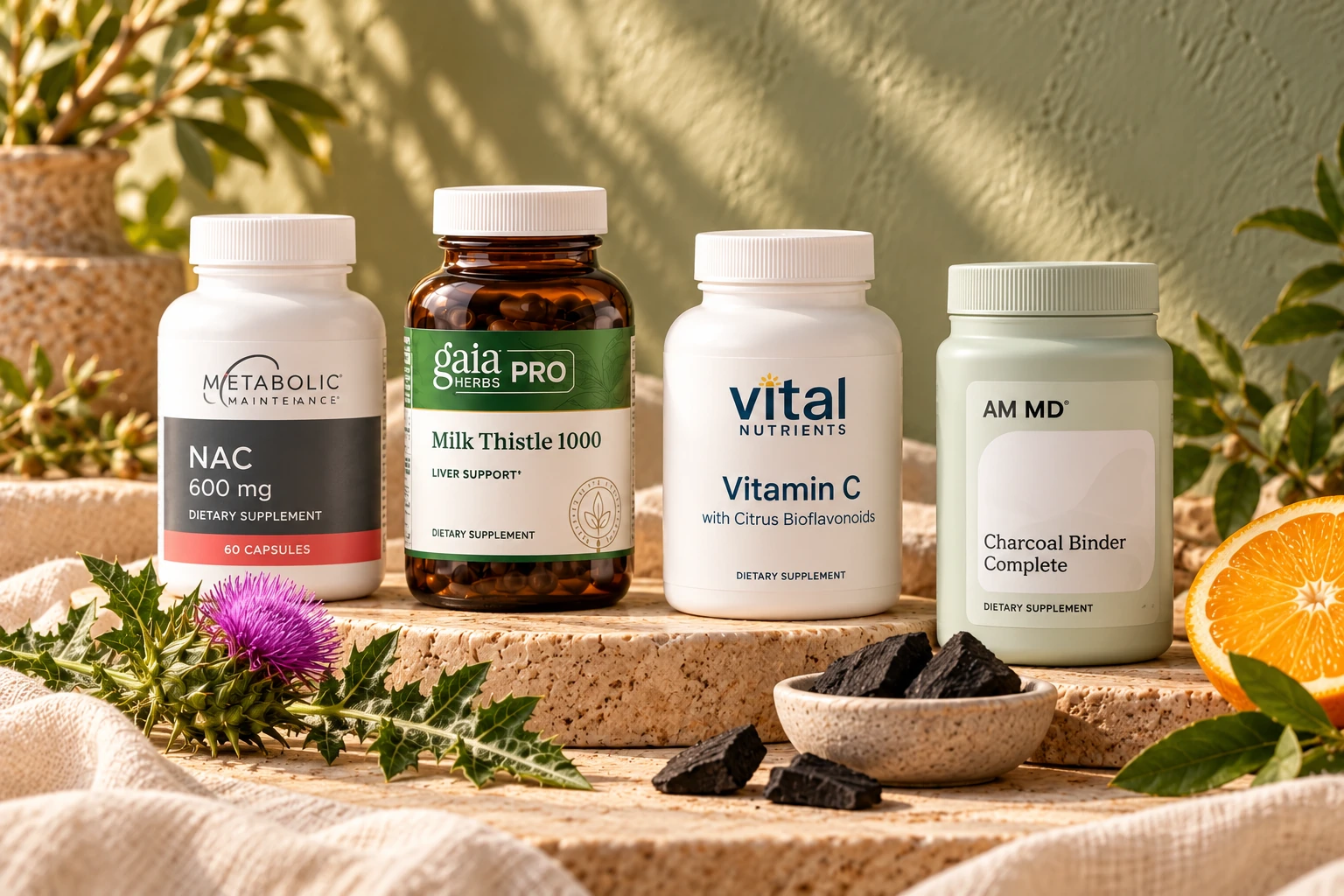
Milk thistle anchors this collection, alongside nutrients for the body’s antioxidant systems, a botanical greens blend, and two distinct binder options. Explore the full edit below, then choose what belongs in your own care. These are individual options; taking the entire collection together is not the starting point.
THE GLUTATHIONE BUILDING BLOCK
Glutathione is one of the body’s own antioxidants, made from three amino acids: cysteine, glycine, and glutamate. NAC—short for N-acetylcysteine—supplies cysteine, a building block for that system. Glutathione helps cells manage reactive molecules and participates in the liver’s processing of certain compounds.
I think of NAC as targeted nutritional support for work already happening inside the body. Its place in this edit begins with that biochemical role, alongside adequate protein and everyday nourishment.
A small study in nine healthy women reported increased whole-blood glutathione after oral NAC. Larger trials of combined glycine and NAC have studied antioxidant and metabolic markers in older adults, but those combinations are not NAC alone. These findings explain the interest in glutathione support; they do not establish that this product removes environmental chemicals or prevents disease.
THE LIVER BOTANICAL
Milk thistle brings a long botanical tradition to the liver conversation. The fruit of Silybum marianum, commonly called the seed, contains silymarin: a family of plant compounds studied for antioxidant activity and their effects on liver cells. It is the botanical anchor of this edit.
The detail I pay attention to is the extract. A defined preparation tells us more than the plant name alone. That is why I look at the species, plant part, and silymarin information when considering how milk thistle may fit within someone’s broader care.
In a 48-week trial involving 99 people with steatohepatitis, silymarin showed improvement in some secondary fibrosis measures. The primary liver-disease activity outcome did not differ significantly from placebo. The preparation and dose studied were not this Gaia product. Laboratory antioxidant findings and clinical outcomes answer different questions.
THE ANTIOXIDANT & COLLAGEN COFACTOR
Vitamin C works in the body’s antioxidant network and helps regenerate vitamin E. It is also needed to make collagen, the structural protein woven through skin, blood vessels, and connective tissue. These are everyday jobs with a place in a well-nourished body.
This formula pairs vitamin C with citrus bioflavonoids, plant compounds found in citrus fruits. I include it here as a nutrient-focused option: consider what food already provides, what other supplements contain, and where additional vitamin C may be useful.
Vitamin C’s roles in collagen synthesis and antioxidant function are established nutritional physiology. Supplement benefit depends partly on baseline intake and the question being studied. Evidence does not establish that adding citrus bioflavonoids makes every vitamin C preparation more effective. Higher doses also have their own tolerability and safety considerations.
THE BOTANICAL GREENS BLEND
A daily ritual can be as simple as stirring a greens blend into a smoothie. This formula brings together leafy plants such as spinach, kale, parsley, alfalfa, and moringa with broccoli sprout, beet root, apple fiber, spirulina, and chlorella. Ginger, turmeric, maca, and ashwagandha root extract round out the botanical mix.
Its place in my edit is convenience and plant variety. Think of it as an addition to a nourishing kitchen: whole vegetables, adequate protein, and fiber-rich meals still do their own essential work. Because this blend also contains concentrated herbs, I review its full label with the same care as any botanical formula.
The manufacturer’s label documents the plant ingredients in this blend. Studies of an individual botanical or a whole-food dietary pattern do not establish the effects of this finished powder or show that it clears an exposure. Ashwagandha adds specific considerations for pregnancy, thyroid and autoimmune conditions, medicines, and liver health.
THE CHARCOAL-LED BINDER
Activated charcoal has a highly porous surface. Certain substances can adhere to that surface inside the digestive tract—a process called adsorption—and leave with the stool. This is a different role from supplying the nutrients the liver uses.
The formula combines charcoal with zeolite, shilajit, chlorella, konjac-derived glucomannan, and spirulina. Glucomannan is a water-holding soluble fiber; the other ingredients give this blend a different composition from charcoal alone. A binder needs a clear purpose and a plan for timing: charcoal can also bind oral medicines, and constipation matters when deciding whether it fits.
Human volunteer and toxicology research shows that activated charcoal can reduce absorption of certain substances when it is present in the digestive tract at the right time. That evidence comes from specific substances, timing, and medical contexts; it does not prove an everyday whole-body detox benefit for this multi-ingredient blend. Charcoal does not selectively bind only unwanted compounds.
THE MINERAL & BOTANICAL BINDER
G.I. Detox+ brings together zeolite clay and activated charcoal with apple pectin, aloe vera leaf extract, silica, and humic powder. Charcoal’s porous surface and zeolite’s mineral structure are the binding-focused part of the formula. Apple pectin is a soluble fruit fiber; aloe, silica, and humic material complete this distinct preparation.
This is another binder option within the collection. I would choose between formulas around the individual situation, bowel habits, medicines, and the reason for use. Its ingredients overlap with Charcoal Binder Complete, so combining the two calls for a specific clinical rationale.
The product label confirms the six-ingredient blend. Adsorption studies and research on separate ingredients help explain the formulation, but they are not equivalent to a human trial showing that the finished product treats a condition or clears a particular exposure. Review medication timing with a pharmacist or clinician; the manufacturer advises against use during pregnancy.
03 · Dr. Burklund’s selected labs
Five testing options from my environmental health collection. Open a test to learn what it measures, how the sample is collected, and the kind of question it can help explore.
Measures selected metals in a venous blood sample. I consider this testing when an environmental, occupational, dietary, or household history raises a specific exposure question. Which metal is measured and when the exposure occurred both affect interpretation. The result helps inform the investigation; it does not provide a complete inventory of every metal stored in the body.
Measures selected metals excreted in urine collected over a full day. The longer collection window provides information about excretion during that period. I interpret the findings alongside the suspected source, timing of exposure, kidney function, and collection instructions; urinary excretion is not the same as the total amount of a metal present in the body.
Looks for selected environmental chemicals or their breakdown products included in the panel. I begin with your exposure history—home, work, water, food, and personal-care products—so the testing has a clear purpose. Results describe the substances measured and can guide a more focused investigation of possible sources; they do not quantify every environmental exposure or establish the cause of symptoms.
Measures arsenic, lead, and mercury in a single urine sample. I consider this option when the exposure history points toward one or more of these metals. Timing, urine concentration, and recent dietary exposures can influence interpretation. Follow the collection instructions carefully, and view the result within a targeted assessment rather than as a general detox score.
Measures selected per- and polyfluoroalkyl substances, a group of persistent environmental chemicals. I consider this information when a history of potential exposure gives us a specific question to explore. Results can document measured levels and support a discussion about reducing ongoing exposure, but they cannot identify the cause of symptoms, predict future illness, or determine treatment on their own.
Research, product information, and clinical guidance address different questions. Product pages describe formulations; they do not establish every claimed benefit.
A thoughtful next step
Open the 6 selections in my Fullscript shop. You can choose individual products.
Compare current labels and ingredients with your allergies, current routine, and individual care plan.
Fullscript shows current pricing, availability, and ordering requirements. There is no need to buy the whole edit.
A few things you may be wondering
No. The collection offers different tools with different roles. Choose around your food intake, health history, current medicines, and the purpose of adding a supplement. The two binders overlap and are not a routine combination.
Begin with regular meals, comfortable bowel function, hydration appropriate for you, and a realistic daily rhythm. If you suspect a particular exposure, identify the source and discuss an appropriate assessment.
Results belong alongside your symptoms, exposure history, sample timing, and previous findings. The next step may involve reducing an exposure, confirming a result, or arranging further assessment. A laboratory number alone does not select a supplement protocol.
Bring those results to your clinician for evaluation of the cause and appropriate follow-up. A new supplement may complicate that picture. Seek prompt care for jaundice, severe abdominal pain, or other concerning new symptoms.
From the Medicine Wild journal
Explore the edits
Educational guidance, not an individual treatment plan. I may earn income from purchases through my Fullscript storefront. You do not need to purchase supplements or tests to explore Medicine Wild or take The Foundations.
These statements have not been evaluated by the Food and Drug Administration. These products are not intended to diagnose, treat, cure, or prevent any disease.
This Medicine Wild article is for informational and educational purposes only. It is not a substitute for professional medical advice, diagnosis, or treatment, and should not be relied upon for individual medical advice. Reading this article or purchasing through the Apothecary does not establish a patient–physician relationship with Dr. Michele Burklund.
The editorial perspective is Dr. Michele Burklund’s unless another source or expert is identified. Linked studies and product information are provided for context; they do not replace advice from a qualified healthcare professional who knows your health history. Consult your clinician about symptoms, medicines, pregnancy or breastfeeding, and the suitability of any supplement or test.